Airport Data and Reports
Airport Layout Plan - September 2022
- Airport Data Sheet Part I
- Airport Data Sheet Part II
- Airspace Plan
- Approach Surface - Runway 13-31
- Approach Surface - Runway 20R
- Approach Surface - Runway 2C-20C
- Approach Surface - Runway 2L
- Approach Surface - Runway 2R-20L
- Existing Layout Plan
- Future Layout Plan
- General Aviation Area Plan
- Land Use Plan
- Location Map & Overview
- Terminal Area Plan
- Westside Area Plan
BNA® Master Plan
In 2020, the Metropolitan Nashville Airport Authority (MNAA) updated the BNA® Master Plan, paving the way for the development and completion of numerous transformative projects under the airport’s first expansion program, BNA® Vision.
Following the successful completion of BNA® Vision in February 2024, Nashville International Airport® (BNA®) entered its next phase of growth: New Horizon. To guide these efforts and plan for future demand, MNAA has begun another update to the 2020 Master Plan. This revision will incorporate completed and ongoing projects, address evolving airport conditions and prepare for anticipated growth in the decades ahead.
The main objectives of the BNA® Master Plan:
The Master Plan process will examine forecasted passenger and operations growth at BNA, evaluate the capacity of existing and planned facilities and identify solutions to meet future demand. This effort will establish a clear development roadmap for BNA through 2047.
Stakeholder and Community Involvement
Engagement with stakeholders and the public was a key component of the planning process. Activities included:
- Public Information Meetings
- Meeting #1: BNA® Master Plan - Community Open House #1
-
- DATE: Thursday, Jan. 22, 2026
- LOCATION: Fifty Forward Donelson Station, 108 Donelson Pike, Nashville, TN 37214
- TOPICS: Airport Master Plan 101, Goals and Objectives, Aviation Forecasts and Facility Requirements
- Meeting #2: BNA® Master Plan - Community Open House #2
- DATE: TBD
- LOCATION: TBD
- TOPICS: Alternatives Analyses and Development Plan
-
- Meeting #1: BNA® Master Plan - Community Open House #1
Technical Advisory Committee and Community Advisory Committee
- A Technical Advisory Committee (TAC) consisting of airport stakeholders that have technical knowledge or orientation directly correlated to the airport. Members included representatives of the federal government, the airline and aviation industries, the aviation community, the Metropolitan Nashville Airport Authority and others.
- A Community Advisory Committee (CAC) consisting of jurisdictional representatives, neighborhood leaders, business leaders and leaders of special interest groups who can offer input on historical, community and regional information that should be considered in the development of the Master Plan.
Meetings: Advisory Committees met four times over the course of the Master Planning Process:
| Meeting Date | Agendas |
|---|---|
| September 2018 | Community Advisory Agenda; Technical Advisory Agenda |
| February 2019 | Community Advisory Agenda; Technical Advisory Agenda |
| June 2019 | Community Advisory Agenda; Technical Advisory Agenda |
| October 2019 | Community Advisory Agenda; Technical Advisory Agenda |
Master Plan Elements
A Master Plan Technical Report was prepared as part of the Master Plan process and includes:
- Inventory of Existing Conditions
- Forecast of Aviation Demand
- Demand Capacity and Facility Requirements
- Alternatives Analysis
- Environmental Overview
- Implementation Plan
- Financial Plan
Separate from the BNA® Master Plan, MNAA will be completing a Noise Exposure Map (NEM) update evaluating existing noise conditions and future (+5 years) noise conditions. The NEM process also includes a community involvement process and information will be provided at the BNA® Master Plan community open houses to support the NEM effort.
Airport Layout Plan
A draft update to BNA’s traditional Airport Layout Plan (ALP) has been created to identify planned developments. The draft ALP, pending approval by the Federal Aviation Administration (FAA), utilizes newly acquired aerial survey data.
Click here to view the Draft Update to the Airport Layout Plan
Construction in Airport Area
In order to prevent obstructions to safe aircraft navigation, the Metropolitan Nashville Airport Authority (MNAA) regulates the maximum height of all structures within the Airport Overlay District. In accordance with this provision, those wishing to obtain building permits within the Airport Overlay District may be required by Metro Government's Department of Codes and Building Safety to contact the Airport Authority 615-275-1446 for sign-off.
In addition, Federal Aviation Regulation Part 77, Objects Affecting Navigable Airspace, establishes standards and notification requirements for objects affecting navigable airspace. Examples of objects that may affect navigable airspace include buildings, communication towers, antenna structures, temporary construction cranes, etc.
Notification as required by Part 77 serves as the basis for:
- Evaluating the effect of the construction or alteration on operating procedures
- Determining the potential hazardous effect of the proposed construction on air navigation
- Identifying mitigating measures to enhance safe air navigation
- Charting of new objects
Notification allows the Federal Aviation Administration (FAA) to identify potential aeronautical hazards in advance, thus preventing or minimizing the adverse impacts to the safe and efficient use of navigable airspace. Notification, if required, is accomplished by completing and submitting an FAA Form 7460-1, Notice of Proposed Construction or Alteration.
All On-Airport construction should be directly coordinated with MNAA.
FAA Advisory Circular 70/7460-2K, Proposed Construction or Alteration of Objects that May Affect the Navigable Airspace, is a publication that provides information to persons proposing to erect or alter an object that may affect the navigable airspace. The publication explains and illustrates the requirement to notify the FAA before construction begins and the FAA's responsibility to respond to these notices in accordance with the requirements of Federal Aviation Regulation Part 77.
NOTICE REGARDING CRANE USAGE NEAR NASHVILLE INTERNATIONAL OR JOHN C. TUNE AIRPORTS: This notice provides information on special requirements for crane usage near Nashville International Airport® (BNA®) and John C. Tune Airport® (JWN®). To obtain additional information or contact the MNAA about crane usage near either airport, please call 615-275-1643.
Economic Impact Study Underscores the Essential Role of
Nashville International Airport® (BNA®) and John C. Tune Airport® (JWN®)
The 2025 Economic Impact Study for Nashville International Airport® (BNA®) and John C. Tune Airport® (JWN®) was conducted by InterVISTAS Consulting, an internationally recognized aviation and transportation consulting firm with a proven record of delivering comprehensive economic impact analyses, air service development initiatives, strategic and business plans, market assessments, and economic recovery strategies for airports, transportation systems, tourism organizations, business associations, and government clients.
The study evaluated calendar year 2024 economic contributions generated by aviation activity, including job creation, personal income, business revenue, and tax generation. The findings demonstrate the far-reaching economic value of BNA and JWN to communities across the state, supporting thousands of jobs, enabling tourism and commerce, and generating substantial federal, state, and local tax revenues.
Key findings include:
Nashville International Airport® (BNA®)
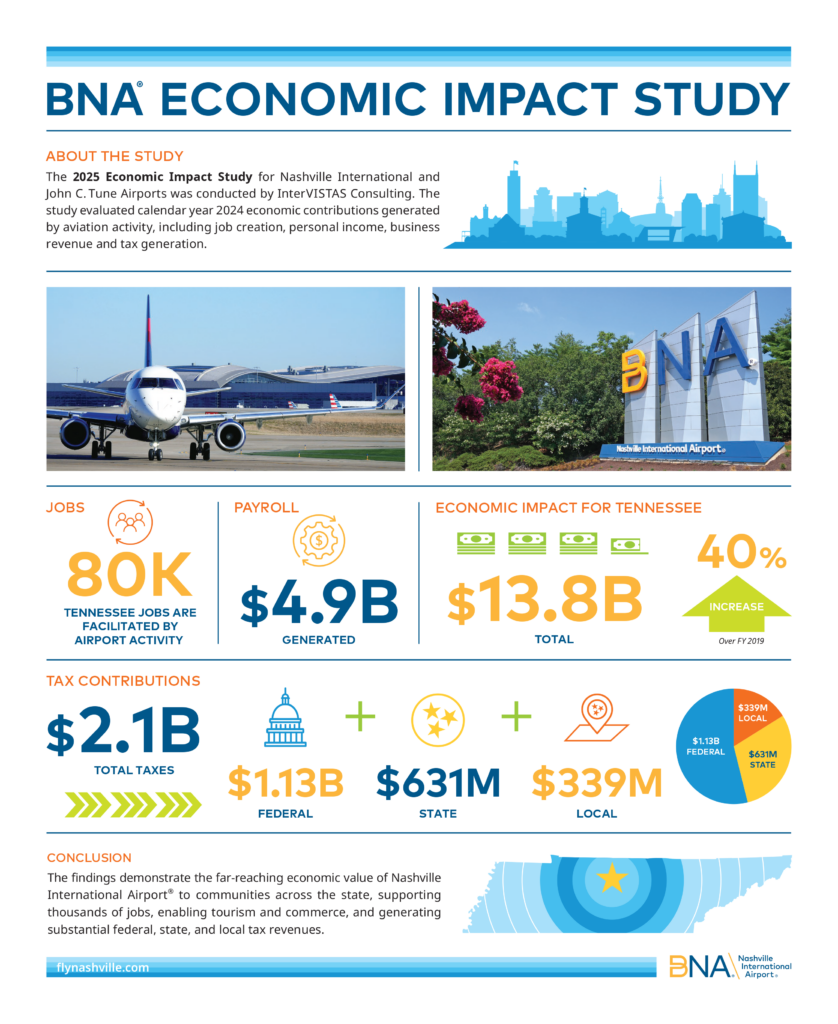
- $13.8 billion in total economic impact for Tennessee, a 40% increase over FY19 study completed by the state of Tennessee
- 80,000 Tennessee jobs are facilitated by airport activity, generating $4.9 billion in payroll
- Contributes to $2.1 billion in total taxes which includes $1.13 billion in federal, $631 million in state and $339 million in local taxes
BNA® Economic Impact
John C. Tune Airport® (JWN®)
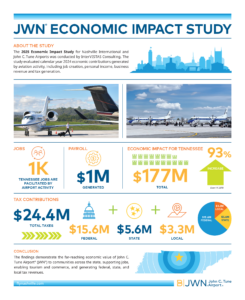
- $177 million in total economic impact for Tennessee, a 93% increase over FY19 study completed by the state of Tennessee
- 1,000 Tennessee jobs are facilitated by airport activity, generating $100 million payroll
- Contributes to $24.4 million in total taxes which includes $15.6 million in federal, $5.67 million in state and $3.3 million in local taxes
JWN® Economic Impact
Metropolitan Nashville Airport Authority (BNA® + JWN®)
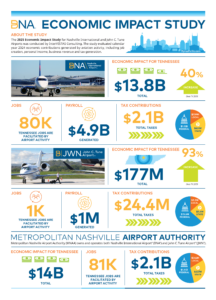
- $14 billion in total economic impact for Tennessee
- 81,000 Tennessee jobs are facilitated by airport activity
- Contributes to $2.1 billion in total taxes which includes $1.14 billion in federal, $637 million in state and $342 million in local taxes
MNAA Total Economic Impact
Download Economic Impact Study Images
These images are the property of the Metropolitan Nashville Airport Authority (MNAA). By downloading, you agree to appropriately credit MNAA in any use or publication.
Annual Comprehensive Financial Reports:
- Annual Comprehensive Financial Report (ACFR) FY25
- Annual Comprehensive Financial Report (ACFR) FY24
- Annual Comprehensive Financial Report (ACFR) FY23
- Annual Comprehensive Financial Report (ACFR) FY22
- Annual Comprehensive Financial Report (ACFR) FY21
- Annual Comprehensive Financial Report (ACFR) FY20
- Annual Comprehensive Financial Report (ACFR) FY19
- Annual Comprehensive Financial Report (ACFR) FY18
- Annual Comprehensive Financial Report (ACFR) FY17
- Annual Comprehensive Financial Report (ACFR) FY16
- Annual Comprehensive Financial Report (ACFR) FY15
- Annual Comprehensive Financial Report (ACFR) FY14
- Annual Comprehensive Financial Report (ACFR) FY13
- Annual Comprehensive Financial Report (ACFR) FY12
- Annual Comprehensive Financial Report (ACFR) FY11
- Annual Comprehensive Financial Report (ACFR) FY10
- Annual Comprehensive Financial Report (ACFR) FY09
- Annual Comprehensive Financial Report (ACFR) FY08
- Annual Comprehensive Financial Report (ACFR) FY07
- Annual Comprehensive Financial Report (ACFR) FY06
- Annual Comprehensive Financial Report (ACFR) FY05
- Annual Comprehensive Financial Report (ACFR) FY04
Annual Reports:
- Annual Report FY20
- Annual Report FY19
- Annual Report FY18
- Annual Report FY17
- Annual Report FY16
- Annual Report FY15
- Annual Report FY14
- Annual Report FY13
- Annual Report FY12
- Annual Report FY11
- Annual Report FY10
- Annual Report FY09
- Annual Report FY08
- Annual Report FY07
Schedules of Collections and Expenditures of Passenger Facility Charges:
- Schedules of Collections and Expenditures of Passenger Facility Charges FY26
- Schedules of Collections and Expenditures of Passenger Facility Charges FY25
- Schedules of Collections and Expenditures of Passenger Facility Charges FY24
- Schedules of Collections and Expenditures of Passenger Facility Charges FY23
- Schedules of Collections and Expenditures of Passenger Facility Charges FY22
- Schedules of Collections and Expenditures of Passenger Facility Charges FY21
Investing in bonds issued by Nashville International Airport® (BNA®) enables the Airport Authority to fund essential public infrastructure projects across the airport. We remain dedicated to upholding strong bond ratings and ensuring transparent communication with both the investor community and the general public.
To explore BNA’s credit profile and learn more about our bond offerings, visit our Investor Relations site for detailed insights and financial information.
- Air Service Incentive Plan (ASIP)
- ASIP Route Summary - FY2026
- Appendix A - Noise and Air Quality Analysis - 2023
- BNA Tarmac Delay Contingency Plan - September 2025
- Central Ramp Environmental Assessment - October 2024
- Comprehensive Supplemental Environmental Assessment for Concourse and Gate Expansion Project - 2023
- Debt Management Policy - July 2020
- Emergency Contingency Plan - May 2012
- FAA Competition Plan - 2023
- FAA Final Environmental Assessment and Finding of No Significant Impact (FONSI) for Concourse and Gate Expansion - July 2021
- FAA Cover Letter Supplemental Environmental Assessment Concourse and Gate Expansion Project | FAA Cover Sheet | Supplemental Environmental Assessment Concourse and Gate Expansion Project - April 2023
- Notice of Availability - Supplemental Environment Concourse and Gate Expansion Program - 2023
- Public Notice: Opportunity for Public Comment - May 2017
- Public Notice: Passenger Facility Charge - July 2024
As a proud partner of the Federal Aviation Administration (FAA), Nashville International Airport® (BNA®) supports the FAA's commitment to efficiently and thoughtfully addressing aircraft noise complaints and public inquiries.
Click Here to File a Noise Complaint
Noise Maps (NEMs)
An airport's noise environment is characterized and represented using the Day-Night Average A-Weighted Sound Level (DNL) metric. Developed by the U.S. Environmental Protection Agency (EPA), the DNL serves as a predictive tool for assessing the long-term effects of environmental noise on populations. Under 14 CFR Part 150, the DNL is mandated as the standard metric for measuring aircraft noise impact and determining land-use compatibility.
Noise Exposure Maps (NEMs), often referred to as "noise contours" or "noise contour maps," do not depict flight paths. Instead, they highlight areas most affected by aircraft noise. Noise levels and the number of aircraft heard on a given day are influenced by factors such as runway usage, weather conditions, flight schedules, and community background noise. Aircraft altitudes vary depending on the type of aircraft and the flight's origin or destination.
NEMs typically display the DNL 65dB contour, which federal guidelines generally recognize as the threshold for significant noise impact from aviation and other community noise sources. Land uses are broadly considered compatible with DNL levels below 65 dB.
Nashville's NEMs were created using the Federal Aviation Administration's computerized Integrated Noise Model (INM), which calculates aircraft sound levels based on an average day’s annual activity.
- Noise Exposure Map for Nashville International Airport (posted Feb. 7, 2020)
- Click here to view (May require a moment to load due to document size)
- Final BNA Noise Exposure Map Figures
- Previously published FAA-Approved BNA Noise Maps (NEMs):
- 2017 Noise Exposure Map
- 2012 Noise Exposure Map
- 2009 Minimum Standards
- 2004 Noise Contours
- 2004 Noise Exposure Map
- 2001 Noise Contours
- 1996 Noise Contours
- 1993 Noise Contours
Past Meetings
- Public Information Open House:
- Held on Thursday, Nov. 21, 2019, to discuss the BNA Master Plan and Noise Exposure Map update.
- Noise Study Advisory Committee Meetings:
- October 2018 – View presentation here
- June 2019 – View presentation here
- October 2019 – View presentation here
FY 2027
FY 2026